Journal ·
Choosing Music for an Award Ceremony: A Running-Order Guide
A ceremony belongs to the people being honoured. Music’s task is to carry the room between them — and then get out of the way.
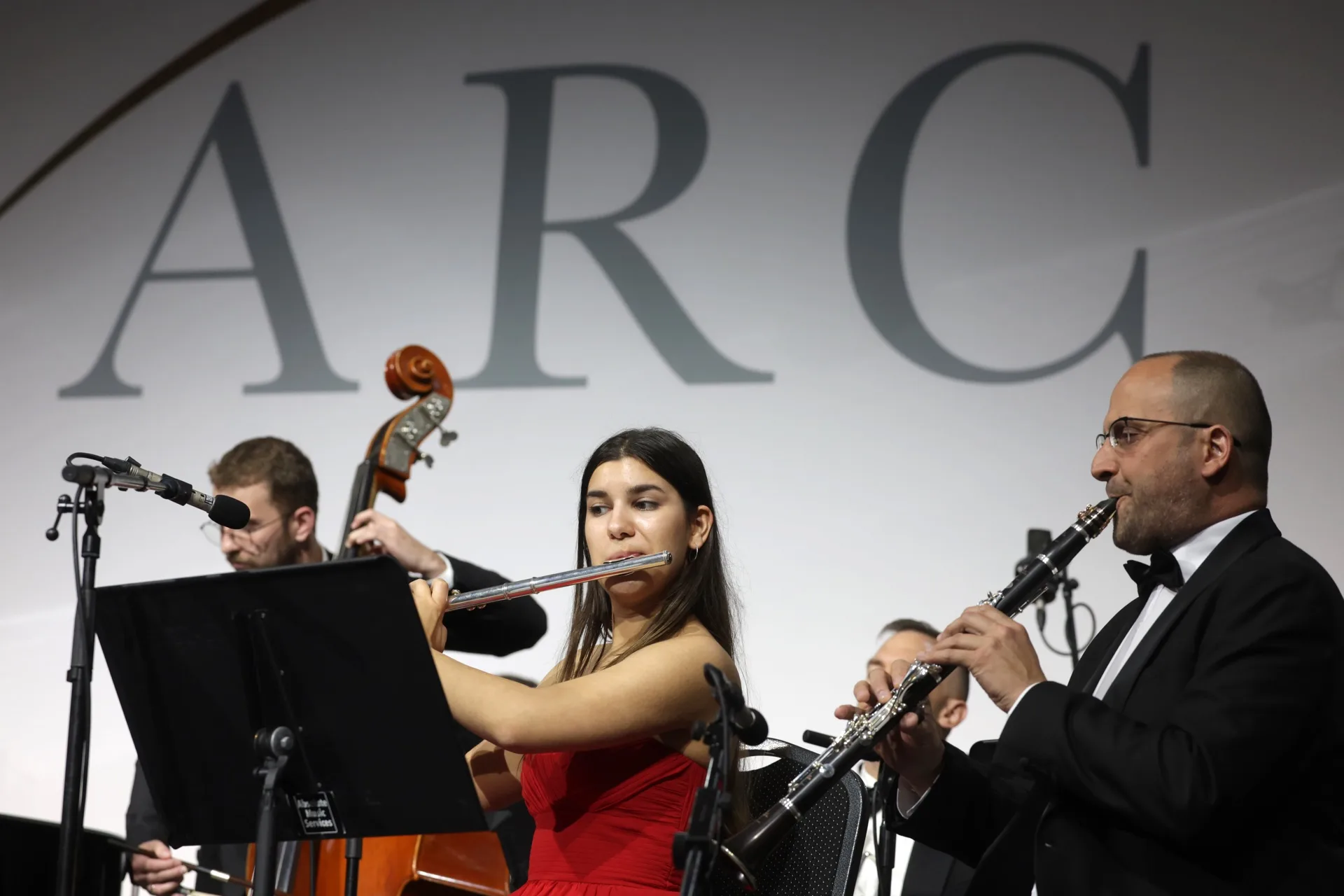
An award ceremony needs less music than most planners expect, placed at four points: as guests arrive, at the moment the room is called to order, once in the middle to break the rhythm of the citations, and at the close. Twenty to thirty-five minutes of performed music across a ninety-minute ceremony is usually right. The rest of the evening belongs to the people being honoured.
The common mistake is to treat music as decoration laid over a timetable. In a ceremony the running order is the design. Every citation, speech and film competes for the same finite attention, and music is the one element that can reset a room without asking anything of it — no listening required, no applause owed.
Where does live music belong in an award ceremony?
The arrival. Playing as guests come in and find their seats does the work no announcement can: it tells a room what kind of occasion it has walked into. Fifteen minutes of unhurried playing, ending as the doors close, is ample.
The call to order. One short, decisive piece — two or three minutes — gathers a talking room far more gracefully than a request to take your seats. It hands the host a silent room rather than one they must win.
The interval within the citations. After five or six awards, attention flattens; every subsequent winner is heard a little less well than the last. A single performance here, placed between categories, resets the room for the second half and quietly honours the awards that follow it.
The close. A warm final piece after the last award turns a list of names back into an evening. It also gives guests something to move to as they rise, which no recorded playout ever quite does.
How long should each musical moment be?
Shorter than in a concert, and shorter than in a gala dinner. Inside a ceremony, three to five minutes is a full musical statement; the mid-ceremony performance can run to eight or ten if it is announced and framed as a moment in its own right. The discipline is to finish while the room is still with you — a ceremony that overruns loses its warmth precisely when the most senior award is being given.
What should play while winners walk to the stage?
Walk-ups are the most under-designed thirty seconds of any ceremony, and live players handle them better than a cue sheet. A short figure that can begin on a name and end on an arrival — extended or cut in the moment — spares you both the awkward silence of a long walk and the ugly fade of a track chopped mid-phrase. Agree in advance how each walk-up begins and, more importantly, how it ends: a musician watching the stage will land the finish with the winner’s first step to the microphone.
The same applies to playoffs. A gracious, unmistakable few bars are the kindest way to close a speech that has run long — firmer than a host’s interruption, and no one’s feelings are hurt.
In a ceremony, music is not the event. It is what makes the event legible.
Protecting the ceremony’s own moments
Some minutes must stay silent. The citation itself, the moment of presentation, an acceptance speech from someone who has waited a career for it — none of these want an underscore, and a photographer’s shutter is the only sound they need. Music placed too close to a solemn or emotional award reads as an intrusion, however beautifully it is played. Decide early which awards are the evening’s peaks, then leave clear air on both sides of them.
Building the running order with the venue and the production team
A ceremony has more moving parts than a concert: a host, a lectern, screens, a photographer, sometimes a broadcast feed. Musicians need their positions and their light agreed alongside all of it. Three questions settle most of the risk. Where do the players sit so that they neither block the screen nor have to cross the stage between awards? Does the room have amplification, and if so, who mixes the ensemble against the lectern microphone? And who calls the cues on the night — the stage manager, the host, or the musical director?
Settle those in the same conversation as the timings, not afterwards. Every ceremony overruns a little; a running order built with the musicians in it will absorb the drift instead of sacrificing the music to it.
A ceremony designed as one arc
The ceremonies people remember are not lists interrupted by entertainment; they are single evenings with a shape — welcome, gathering, recognition, celebration. That is how we work. Camerata Bulgarica is a Sofia-based cultural production company that designs and performs bespoke classical and chamber-music experiences for conferences, forums, galas and institutional events across Europe. From 2023 to 2026 we conceived and produced the musical dimension of four successive editions of the ARC conference, where the same principle held: music placed to welcome, to reflect, to celebrate and to create stillness, rather than simply to fill the air.
Choosing the music, in the end, comes after choosing the moments. Decide what the evening is honouring and where it should lift, and the programme almost writes itself.
If you are planning one now
If you are shaping a prize-giving, an anniversary or an honours evening, you can read how we approach music for galas, ceremonies and diplomatic occasions, see the companion guide on how much stage time works at a gala dinner, or simply start an inquiry — we reply personally, with questions rather than a brochure.